
Latest blog
Single blog post
July 30, 2026
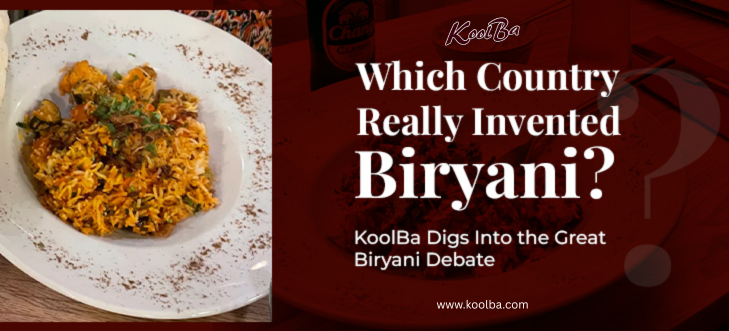
Which Country Really Invented Biryani? KoolBa Digs Into Food's Oldest Debate
Few dishes spark as much passionate disagreement at the dinner table as biryani. Ask ten people where it comes from and you'll likely get ten different answers — Iran, India, Pakistan, even Central Asia all lay some claim to it. At KoolBa, where Persian and Indian flavours share the same kitchen, we get asked this question all the time. So we decided to dig into the history and lay out what's actually known.
It Starts With a Persian Word
The name itself is the first clue. "Biryani" is widely believed to descend from the Persian word birian, meaning "fried before cooking," or from birinj, the Persian word for rice. That linguistic root is why so many food historians trace the dish back to Persia, where rice was traditionally roasted in ghee before anything else went into the pot — a technique still used today in Persian pilaf.
But a name pointing to Persia doesn't settle the matter. Food, like language, travels and transforms as it crosses borders — and biryani's journey is a long one.
An Older Rice Dish in the South
Long before the Mughals arrived in India, there's evidence of a spiced rice-and-meat dish in the Tamil region. Tamil poems dating as far back as 200 CE mention a dish called Oon Soru — rice cooked with ghee, meat, turmeric, and pepper, originally prepared to feed soldiers. Some historians point to this as proof that India had its own tradition of layered, spiced rice centuries before any Persian influence arrived.
The Mughal Kitchens Made It Iconic
Whatever its roots, biryani as we recognise it today — fragrant basmati rice, slow-cooked meat, saffron, and the signature dum (sealed-pot) style of cooking — came into its own under the Mughal Empire, between the 16th and 19th centuries. According to food historian Lizzie Collingham, the Mughal royal kitchens blended native Indian spiced-rice traditions with the Persian pilaf brought over by the Mughals' Central Asian ancestry, creating something genuinely new.
From there, biryani splintered into distinct regional identities:
- •
Hyderabadi biryani developed under the Nizams, blending Mughal technique with local Deccan spice.
- •
Awadhi (Lucknowi) biryani favoured a lighter, more delicately spiced style from the Nawabs' kitchens.
- •
Kolkata biryani was born in the 1850s when the exiled Nawab Wajid Ali Shah's chefs, working with limited meat, added potatoes and eggs to stretch the dish — a twist that's now a defining feature.
So, Which Country Actually Invented It?
The honest answer: it's contested, and probably always will be. The strongest case is that biryani's technique and name have Persian origins, while its soul — the specific spice blends, regional variations, and the dish's place in South Asian identity — was shaped in the Indian subcontinent over centuries. It's less a single invention and more a slow, layered collaboration between empires, migrations, and home kitchens.
That's arguably why biryani still divides opinion today — because no one country gets to own it outright.
Taste the Debate for Yourself
At KoolBa, we like to think of biryani as a dish that belongs to everyone who's ever cooked it with care — Persian, Mughal, Hyderabadi, or Kolkata-style. Come taste our own take on it and decide which side of history you're on.